Case studies

In each case study, we compare two board or fin types the surfer can ride well. We include one example model per type just for illustration; many other boards could work equally well.

CASE STUDY  A

Beachbreak - Small windswell

The Scenario

Wave type

Beachbreak

Wave height

1 meter (3 ft)

Wave period

8 seconds

Conditions

Crowded

Surfer

Intermediate

Quiver

6’0″ all round shortboard

7’0″ all round mid length

6’0″ all round shortboard

Example model

Chilli – Middy

6’0″ x 20 5/8″ x 2 7/16″ (33.20 L)

Chilli Surfboards Middy small

Best Choice

7’0″ all round mid length

Example model

Chilli – Mid Strength

7’0″ x 21 3/4″ x 2 3/4″ (45.50 L)

Chilli Surfboards Mid Strength small

Choose the 6’0″ shortboard

✓  Stronger paddle-acceleration

  • In a beach break where peaks shift constantly, you need to reach the peak fast.
  • In a crowded lineup you need to react quickly to get to the wave first.
  • With a short wave period (8 seconds), you have limited time to position and generate the initial speed needed to catch the wave.

✓  Better maneuverability in small 1-meter waves, a shorter board lets you turn more easily in limited space.

Why not the 7’0″ board?

Although the 7’0″ board has a higher maximum paddle speed, you won’t have enough time to reach it. In this scenario, it’s better to reach a certain paddle speed quickly. A larger board also limits your maneuverability in small waves.

CASE STUDY  B

Pointbreak - Long period swell

The Scenario

Wave type

Pointbreak

Wave height

1,5 meter (5 ft)

Wave period

14 seconds

Conditions

Some surfers out

Surfer

Intermediate

Quiver

6’0″ all round shortboard

7’0″ all round mid length

6’0″ all round shortboard

Example model

Chilli – Middy

6’0″ x 20 5/8″ x 2 7/16″ (33.20 L)

Chilli Surfboards Middy small

7’0″ all round mid length

Example model

Chilli – Mid Strength

7’0″ x 21 3/4″ x 2 3/4″ (45.50 L)

Chilli Surfboards Mid Strength small

Best Choice

Choose the 7’0″ mid length

✓  Higher maximum paddle speed

  • Long-period travel faster, you need a board with a higher maximum paddle speed to match them.
  • Long-period swells give you enough time to build up to that maximum speed.
  • With less crowd, there is less pressure to react instantly, initial speed is less important.
  • On a point break the takeoff zone is well defined, there is no need to search for peaks, reducing the need for rapid acceleration.

✓ On these waves there is also no disadvantage to extra length, since the open face provides enough space to turn smoothly

Why not the 6’0″ board?

On a point break with a long-period swell, the 6’0″ board is less suitable because you may not be able to match the wave’s speed, meaning you will not catch the wave. Once you’re up and riding, the shorter board is no longer a disadvantage.

CASE STUDY  C

Fins for big waves

The Scenario

Wave type

Beachbreak, reefbreak or pointbreak

Wave height

+ 3 meter (+ 10 ft)

Wave period

+ 10 seconds

Conditions

All

Surfer

Intermediate, advanced (80 kg – 176 lb)

Fin quiver

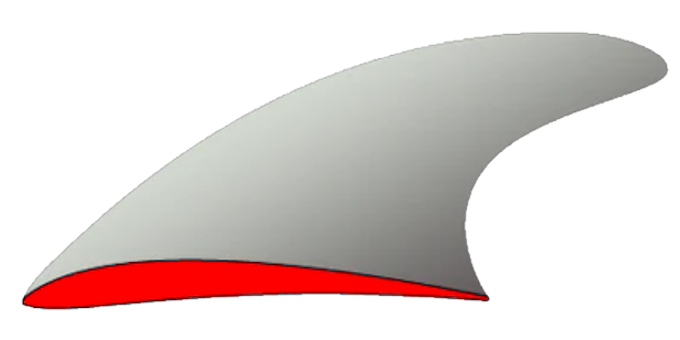
Large fin with inside foil

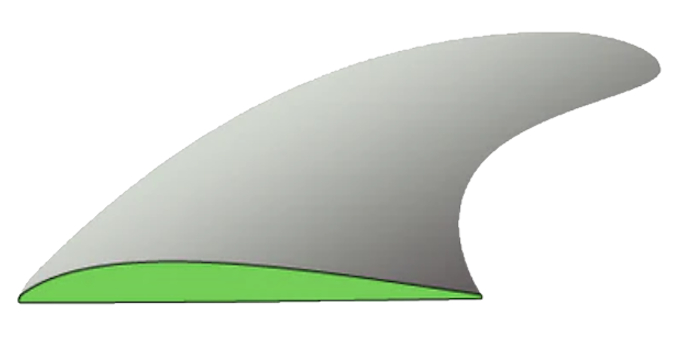
Medium fin with flat foil

Large fin with inside foil

Inside foiled fin

Example model

FCS II – Performer Large

FCS performer fin

Medium fin with flat foil

Flat foiled fin

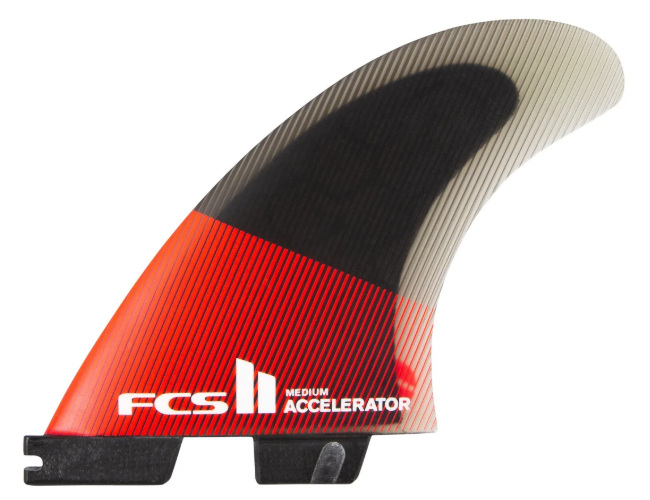
Example model

FCS II – Accelerator Medium

FCS accelerator fin

Best Choice

Choose the medium fin with flat foil

✓ Lower lift and drag forces
  • In big, fast waves the forces on the fin become very large, because force grows with the speed squared.
  • A smaller fin reduces these forces by around 10%.
  • A flat foil instead of an inside foil lowers them by another 15%.
✓ More control over the board
  • A smaller flat-foiled fin keeps the forces lower, so you’re still able to correct with your legs.
  • Lower forces make a small mistake easier to absorb, so the board stays smooth instead of grabbing or chattering.
  • Less drag lets you keep the speed to make sections or outrun the lip

Why not the large fin with inside foil?

In big, fast waves the large fin with inside foil produces too much lift and drag. These forces slow you down and become too big to control with your legs.

Want the full explanation?

In the video we work out what a fin actually does and what happens to the forces when the wave gets bigger.

Speed is squared in the equation, so a six metre wave puts around nine times more force on the fin than a one metre wave.

From there it shows how going down a size and switching to a flatter foil brings those forces back into a range you can control.

CASE STUDY  D

Teahupo'o – 3 meter barrel

The Scenario

Wave type

Reefbreak

Wave height

3 meter (10 ft)

Wave period / swell direction

14 seconds / South swell

Conditions

All

Surfer

Advanced, expert

Quiver

6’6″ CI Goldie

6’6″ CI Pro Step Up

6’6″ CI Goldie

6’6″ x 19 1/2″ x 2 9/16″ (33.80 L)

CI Goldie outline

Best Choice

6’6″ CI Pro Step Up

6’6″ x 19 3/8″ x 2 1/2″ (33.40 L)

CI Pro Step Up outline

Choose 6’6″ CI Goldie

✓ Rocker
  • A 14 second south swell at Teahupo’o gives a wave where you can set your line, stay deep in the barrel and make it out.
  • The CI Goldie has less tail rocker than the CI Pro Step Up. In this barrel you don’t need that much tail rocker, so the Goldie keeps its speed better.
✓ Bottom contour
  • The CI Goldie has a double concave, which helps with directional stability. Once you set your line the board keeps going in that direction.
  • That stability is worth a lot on the foam ball, where the water under the board is far from clean.
✓ Rails
  • The CI Goldie has thinner rails. They sit a little deeper in the wave and hold better in a steep wall.

Why not the 6’6″ CI Pro Step Up?

The CI Pro Step Up has more tail rocker than the curve of the wave at the tail, so the board slows down. The bottom contour gives less directional stability and the rails are a bit fuller, so they hold less.